
Table of Contents
Discover the major risks of AI in operational technology, including cybersecurity vulnerabilities, reliability concerns, and mitigation strategies for safer industrial automation.
Introduction to AI in Operational Technology
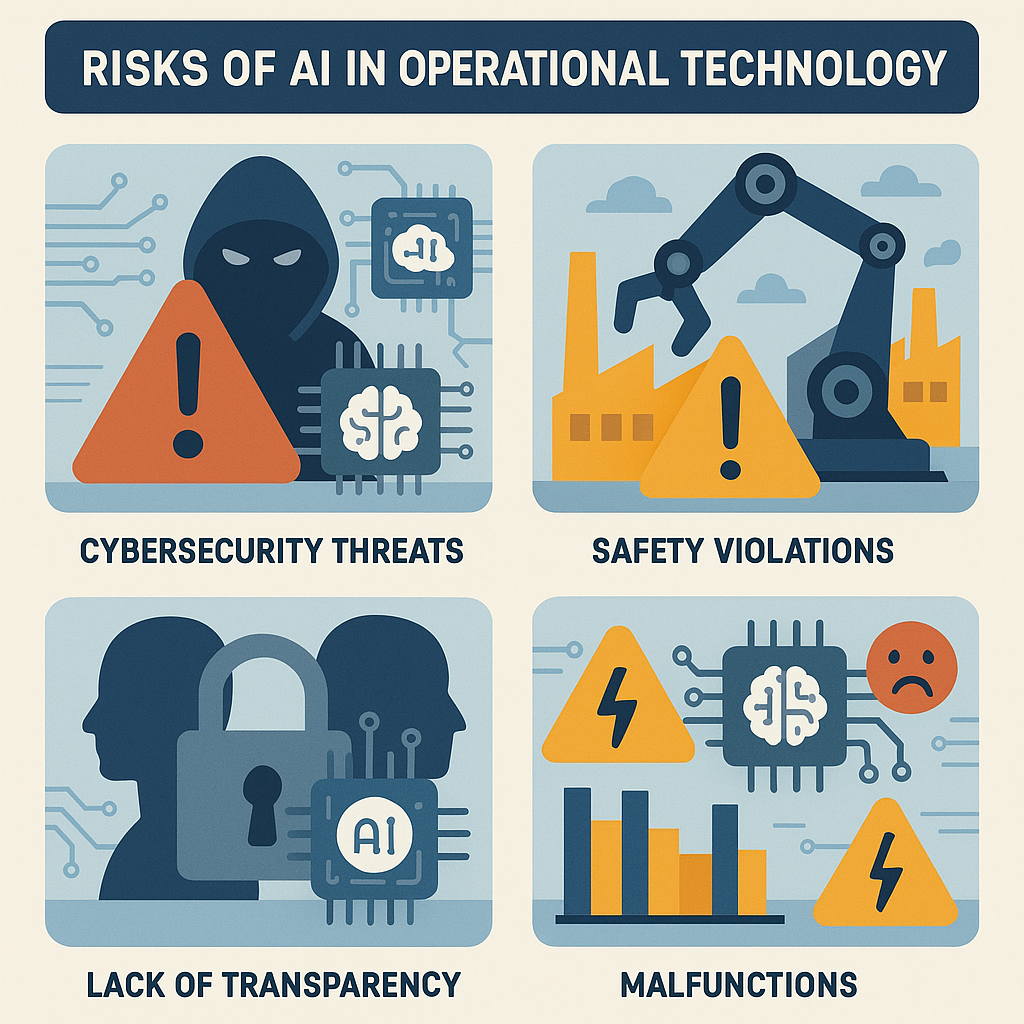
Artificial intelligence (AI) is rapidly transforming industries, but it also introduces new threats—especially in operational technology (OT) environments. Understanding the risks of AI in operational technology is crucial for safeguarding critical infrastructure, ensuring cybersecurity, and preventing system failures that can impact millions of lives. From manufacturing lines to power grids, oil pipelines, and smart city networks, AI promises unprecedented efficiency, real-time decision-making, predictive maintenance, and autonomous control capabilities. However, the growing integration of AI into Operational Technology (OT) environments—systems that directly control machinery, physical processes, and infrastructure—also introduces a wide spectrum of unforeseen risks. Unlike Information Technology (IT) systems, where a cybersecurity failure might lead to stolen data or temporary service outages, a malfunction or compromise in OT can result in severe real-world consequences: equipment damage, hazardous chemical leaks, large-scale blackouts, or even loss of human life.
The complexity of these environments creates unique challenges. Traditional OT systems were built to prioritize reliability and safety over adaptability and innovation. AI introduces new dynamics—learning algorithms that adapt over time, dependence on vast datasets, cloud-based analytics, and third-party integrations—that significantly expand the attack surface and introduce unpredictability into otherwise stable control environments. As AI becomes more intertwined with critical infrastructure, the risks it brings need careful assessment. This article explores cybersecurity vulnerabilities, operational reliability threats, and mitigation strategies to help organizations understand the dangers of AI in OT and implement stronger safeguards before widespread deployment makes these risks unmanageable.
What is Operational Technology (OT)?
Operational Technology refers to hardware and software systems that directly monitor, control, and manage physical processes in industrial settings. This includes industrial control systems (ICS), programmable logic controllers (PLCs), supervisory control and data acquisition (SCADA) systems, and distributed control systems (DCS) found in sectors like energy, manufacturing, oil and gas, water utilities, and transportation. Unlike IT systems that manage data and digital assets, OT systems have real-world consequences—they control valves, pressure levels, turbines, conveyor belts, robotic arms, and more. A malfunction or compromise doesn’t just mean corrupted files; it can mean catastrophic safety failures or environmental disasters.
Traditionally, OT networks were designed to operate in isolation with proprietary protocols, making them relatively resistant to cyber threats. However, Industry 4.0 has transformed this landscape by connecting OT systems to IT networks, the cloud, IoT devices, and AI-powered analytics platforms. This increased connectivity allows for real-time data sharing, predictive maintenance, and remote management, but it also exposes previously air-gapped critical systems to potential cyberattacks and unpredictable behavior caused by AI algorithms acting on flawed or manipulated data. As OT moves into this interconnected ecosystem, understanding the unique risks AI introduces is crucial for maintaining operational safety and resilience.
Cybersecurity Vulnerabilities Introduced by AI
Cybersecurity is arguably the largest single area of risk when integrating AI into OT systems. While AI can strengthen defenses by identifying threats faster than traditional methods, it also creates new attack surfaces and pathways for adversaries. The combination of physical control systems, machine learning models, and increased network exposure makes AI-driven OT environments high-value, high-impact targets for cybercriminals and nation-state actors alike.
One significant risk is that AI models depend on massive streams of data to make operational decisions. These datasets often come from sensors, external feeds, or vendor-provided sources. If attackers manipulate this data, they can influence AI decision-making in subtle yet harmful ways. For example, in a smart grid system, feeding falsified energy demand data into the AI could result in power rerouting that overloads transmission lines, causing large-scale blackouts. Similarly, adversaries can launch adversarial machine learning attacks, where they craft inputs specifically designed to confuse or mislead AI models, resulting in dangerous control instructions being executed.
The growing complexity of AI systems also creates more entry points for attackers. AI often requires cloud-based computing power or third-party algorithmic services, meaning data must flow between multiple networks. Each connection point increases the risk of intrusion. A single compromised API or vendor library could provide a gateway into the core control systems of critical infrastructure. Furthermore, AI-powered cyberattacks are evolving—attackers can now deploy self-learning malware that adapts to defensive measures, prolonging its presence within OT systems while evading detection. In an environment where milliseconds matter—such as nuclear plant cooling systems or gas pipeline pressure controls—delays in threat detection caused by AI vulnerabilities could lead to catastrophic consequences.
Another layer of cybersecurity concern is prompt injection and model exploitation, particularly in newer AI-driven interfaces. As natural language interfaces become part of OT operations—allowing engineers to interact with AI models via conversational commands—attackers may embed malicious instructions within input data. The AI system might interpret these as legitimate commands, overriding human safety protocols or initiating unexpected shutdowns. Such vulnerabilities highlight a troubling reality: AI models are not only vulnerable to traditional hacking but can also be socially engineered through their data inputs, making them unpredictable in critical safety environments.
Finally, the supply chain risk looms large. AI models are often pre-trained by external vendors or built on open-source frameworks. A compromised algorithm—whether intentionally backdoored or unknowingly flawed—can propagate across multiple industries, creating a single point of failure affecting energy grids, water plants, and manufacturing simultaneously. The 2020 SolarWinds cyberattack demonstrated how one vendor compromise can ripple across thousands of organizations; AI-driven OT could magnify such effects exponentially.
Operational and Reliability Risks
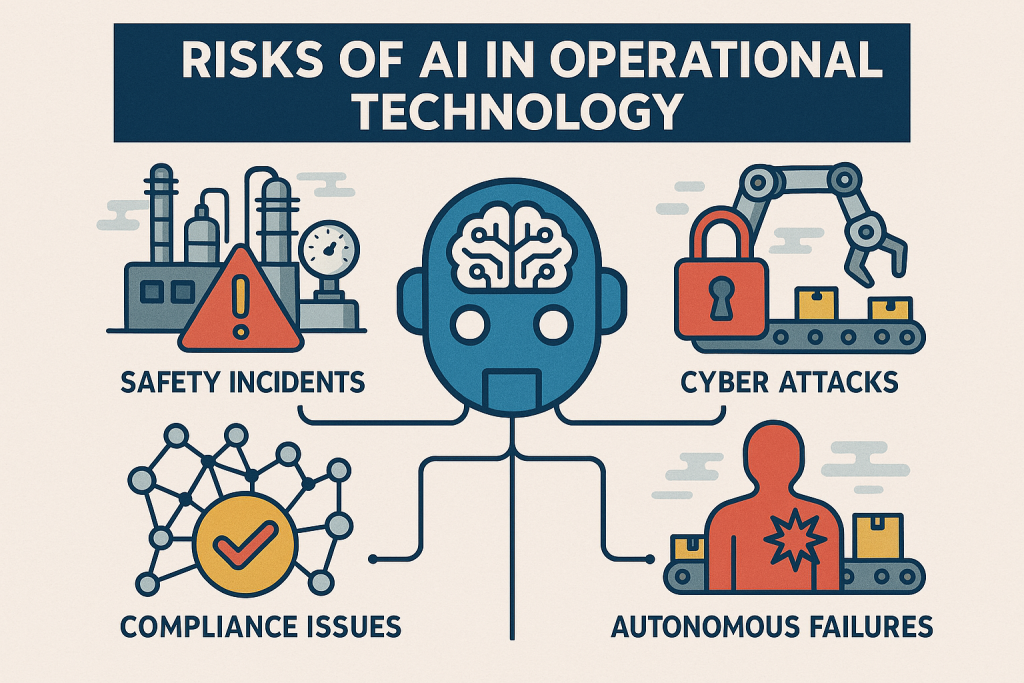
Even without malicious attacks, AI integration into OT environments presents significant operational reliability risks that can threaten safety, efficiency, and long-term stability. The complexity of industrial processes combined with the unpredictable nature of machine learning creates conditions where mistakes can quickly cascade into costly—and potentially catastrophic—events.
One of the biggest concerns is the occurrence of false positives and false negatives in AI-driven decision-making. Predictive maintenance algorithms, for example, rely on sensor data and historical patterns to forecast equipment failures before they occur. If an AI model misinterprets fluctuations in data, it may trigger emergency shutdowns unnecessarily. In a large-scale factory or energy plant, such shutdowns can halt production, damage sensitive equipment, and cause millions of dollars in losses due to downtime. On the other hand, false negatives—where the AI fails to detect an imminent problem—are far more dangerous. Imagine an AI system responsible for monitoring pressure levels in a natural gas pipeline. If the system overlooks a small but growing leak due to flawed training data or sensor misreadings, it may fail to initiate corrective actions in time, resulting in an explosion or environmental disaster.
Another critical issue is model drift, which refers to the gradual degradation of an AI model’s accuracy over time. OT environments are not static; they evolve as machinery ages, production requirements change, and external factors like temperature or humidity vary. An AI system that performs well during initial deployment may become unreliable months or years later if it isn’t retrained regularly with fresh, high-quality data. A drifted model might make unsafe operational recommendations, fail to recognize new forms of mechanical stress, or misclassify safety hazards. Since OT systems often run continuously and control life-critical processes, even minor inaccuracies can have disproportionate consequences.
Perhaps the most profound challenge is the lack of explainability in AI decision-making. Many of today’s machine learning models, particularly deep neural networks, function as “black boxes”—they can provide predictions or recommendations without transparent reasoning. In a safety-critical OT environment, this lack of interpretability can paralyze human operators during emergencies. For example, if an AI system instructs operators to shut down a cooling system in a nuclear plant without clear justification, engineers may hesitate to act, unsure whether the command is legitimate or the result of a data anomaly. Delayed responses in such high-stakes scenarios can escalate minor issues into large-scale disasters. Furthermore, regulators are increasingly concerned about AI-driven OT decisions that lack auditability, raising legal and compliance challenges for companies deploying these technologies.
In essence, while AI promises efficiency and proactive maintenance, its unpredictable errors, data sensitivity, and opaque decision-making can compromise the very safety and reliability that OT systems are built to ensure. Without rigorous oversight and testing, organizations risk allowing AI to make life-or-death decisions without adequate human validation.
Best Practices to Mitigate AI Risks in OT
To harness AI’s benefits while minimizing its risks, organizations need to adopt comprehensive, proactive strategies for AI integration in OT. This goes beyond simply installing cybersecurity software or monitoring networks—it requires building a robust ecosystem of governance, human oversight, security hardening, and continuous evaluation.
The first crucial step is establishing AI governance frameworks tailored for critical infrastructure. Governance defines clear accountability for AI-driven actions, ensuring that responsibility doesn’t fall into a grey area between data scientists, engineers, and operations managers. Companies should enforce rules that prohibit fully autonomous AI decision-making in high-risk systems unless safety is assured and a human operator can intervene instantly. Ethical guidelines must also be implemented to address bias, ensure fairness in AI-driven resource allocations, and maintain transparency for regulatory compliance. Regular audits should be conducted using internationally recognized standards like IEC 62443 and the NIST AI Risk Management Framework to verify that AI models behave as expected under various operational conditions.
Cybersecurity must be significantly hardened for AI-enabled OT systems. Organizations should adopt a zero-trust architecture, limiting system access to only verified users and devices. Network segmentation and air-gapping can reduce the potential for cross-system contamination in case of an attack. AI models and supporting infrastructure should undergo constant vulnerability testing, and supply chain risks must be closely monitored by vetting vendors and scanning pre-trained models for embedded threats. The goal is to ensure that AI doesn’t become an exploitable “weak link” in otherwise well-protected control systems.
Another cornerstone of risk mitigation is maintaining human-in-the-loop decision-making. AI should be viewed as an assistant—not a replacement—for human operators in OT environments. High-impact decisions, particularly those involving safety protocols, must require human approval before execution. This setup ensures that machine predictions are balanced with human expertise and contextual judgment. To enable this, AI systems should provide clear explanations for their recommendations, translating complex model reasoning into understandable insights for engineers. Training programs for OT personnel should include education on AI limitations, equipping them to question and override machine outputs when necessary.
Finally, organizations must commit to continuous monitoring, rigorous testing, and the deployment of fail-safe mechanisms. AI models should be stress-tested against a wide range of scenarios, including rare but high-impact edge cases. Redundant systems and manual override capabilities should be maintained to ensure that AI failures or cyber intrusions do not lead to uncontrollable events. Furthermore, a safe fallback state should always be defined—if an AI model’s confidence level drops below a threshold or if its behavior appears abnormal, the system should revert to pre-defined manual controls immediately.
By combining these best practices—governance, security hardening, human oversight, and ongoing testing—organizations can build trustworthy AI implementations that enhance OT operations without introducing unacceptable risks. The future of industrial automation depends not on eliminating AI, but on deploying it responsibly, safely, and transparently.
Conclusion
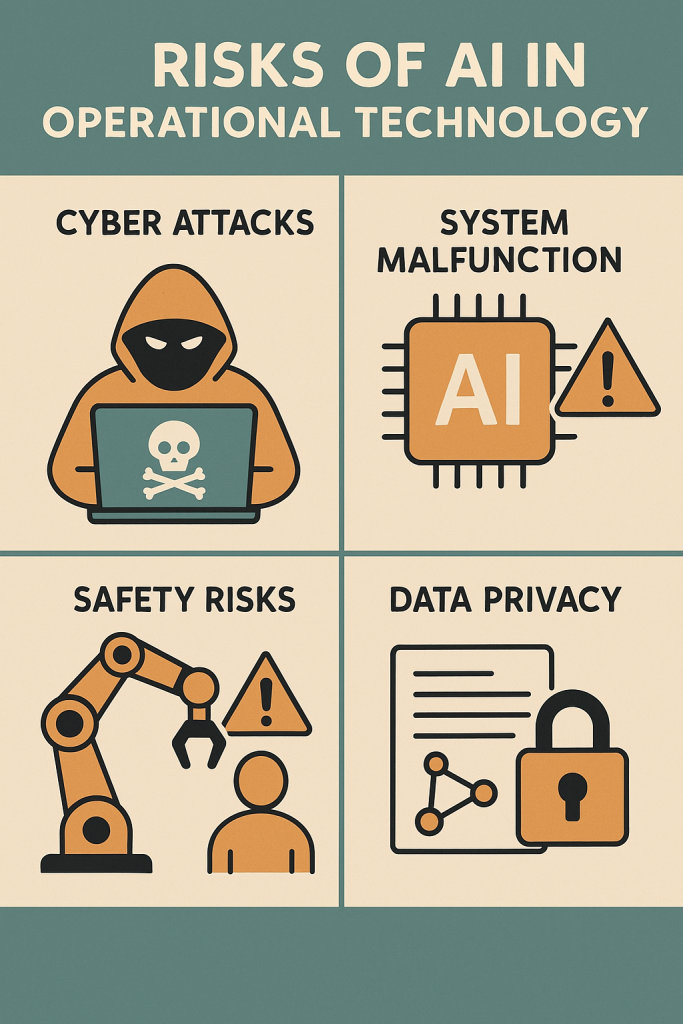
AI is reshaping operational technology, driving innovation and efficiency at a pace never seen before in industrial history. Yet, its integration into critical infrastructure also multiplies potential risks, from cybersecurity vulnerabilities and data manipulation to reliability failures and opaque decision-making. Unlike traditional IT risks, which typically involve data breaches or financial loss, AI risks in OT can directly threaten human safety, environmental stability, and national security.
The stakes are too high to ignore. Organizations must take a measured, cautious approach to AI deployment in OT environments, combining technological advancements with strong governance, layered cybersecurity defenses, human oversight, and resilient fallback mechanisms. As regulatory frameworks mature and explainable AI technologies evolve, it’s possible to create OT systems where AI acts as a powerful ally rather than a liability.
In the end, AI in OT is not inherently dangerous—but unchecked, untested, and poorly secured AI certainly is. The path forward lies in balancing innovation with rigorous safeguards, ensuring that industrial automation remains not just smarter, but safer for everyone it serves.
Understanding and mitigating the risks of AI in operational technology is critical to safeguarding critical infrastructure and maintaining operational safety
Frequently Asked Questions (FAQs) – Understanding the Risks of AI in Operational Technology
1. What are the main cybersecurity risks of AI in operational technology systems?
The primary risks of AI in operational technology stem from its reliance on vast datasets, interconnected networks, and complex algorithms that attackers can manipulate. A significant risk is data poisoning, where cybercriminals feed false or misleading data into AI models, causing incorrect operational decisions. This could alter safety thresholds or trigger unnecessary shutdowns, disrupting critical infrastructure like power grids or water supply systems (CISA – ICS Cybersecurity).
Another concern is adversarial machine learning attacks, where attackers craft malicious inputs to confuse AI models. For example, a manipulated sensor reading could make an AI-driven control system believe equipment is functioning normally when it’s near failure. Without layered cybersecurity protections, the risks of AI in operational technology increase, potentially exposing vital systems to large-scale disruptions.
2. How can organizations safely implement AI in OT environments?
Safe AI implementation begins with acknowledging the risks of AI in operational technology and applying a Zero Trust cybersecurity approach. Organizations should establish strong AI governance frameworks to ensure accountability and traceability of automated decisions.
Technically, enforce network segmentation, use verified data sources to avoid data poisoning, and deploy intrusion detection systems specifically designed for industrial networks. Maintaining a human-in-the-loop approach ensures that operators can validate AI recommendations before execution (NIST AI Risk Management Framework).
Simulating cyberattacks and operational failures before deployment further minimizes risks, while regular patching and continuous monitoring reduce exposure to new vulnerabilities.
3. What industries face the highest risks from AI-driven OT failures?
Industries with real-time physical control processes face the greatest AI-related OT risks:
- Energy and Utilities: AI errors could lead to blackouts, water contamination, or safety hazards in nuclear plants (DOE Cybersecurity).
- Oil and Gas: Faulty AI predictions could mismanage pressure levels, causing fires, explosions, or environmental damage.
- Manufacturing: AI malfunctioning could halt production lines or damage expensive machinery.
- Transportation: Incorrect AI decisions could disrupt railway signaling, traffic control, or aviation safety.
- Healthcare: AI-powered medical OT systems could malfunction during surgeries or patient monitoring, directly endangering lives.
These sectors are particularly vulnerable because the risks of AI in operational technology directly affect human safety, environmental health, and economic stability.
4. How can AI bias affect decision-making in operational technology systems?
AI bias is another factor that increases the risks of AI in operational technology. It occurs when algorithms make decisions based on incomplete or skewed datasets. In OT systems, this can lead to unsafe operational decisions.
For example, predictive maintenance models trained on limited data might fail to detect certain failures, resulting in missed safety warnings. Similarly, smart grid AI could allocate energy unfairly, prioritizing industrial users over emergency services during peak demand. These flaws highlight that the risks of AI in operational technology include not just cyberattacks, but flawed AI logic and unbalanced decision-making (NIST Bias in AI Guidance).
5. What supply chain risks does AI introduce into OT environments?
AI often relies on third-party software, pre-trained models, and hardware components, introducing supply chain vulnerabilities that amplify the risks of AI in operational technology. A compromised AI model could create hidden backdoors, allowing attackers to manipulate data or disable safety protocols.
Infiltrated software updates, tampered firmware, or compromised sensors can also feed false information to AI systems, causing cascading operational failures. Organizations should enforce secure vendor risk management practices, require digitally signed code, and implement redundancy in safety systems to reduce these supply chain risks (CISA Supply Chain Security).
6. What regulations and compliance requirements govern AI use in OT systems?
Several frameworks guide safe AI use in OT systems. In the U.S., NIST’s AI Risk Management Framework outlines best practices for trustworthy AI. The EU AI Act classifies AI applications in OT as high-risk, requiring strict conformity assessments and human oversight.
Additional standards include IEC 62443 for industrial cybersecurity and ISO/IEC 23894 for AI risk management. Following these frameworks helps organizations reduce the risks of AI in operational technology, ensure compliance, and protect public safety.
Next Steps for Your OT Security
Integrating AI into OT systems can improve efficiency and safety, but only with proper cybersecurity controls, testing, and governance.
- Review your AI supply chain security regularly.
- Follow recognized frameworks like NIST and IEC 62443.
- Maintain human oversight for all critical safety actions.
For a deeper dive into OT cybersecurity strategies, visit our guide on Automating Security Risk Management for OT.